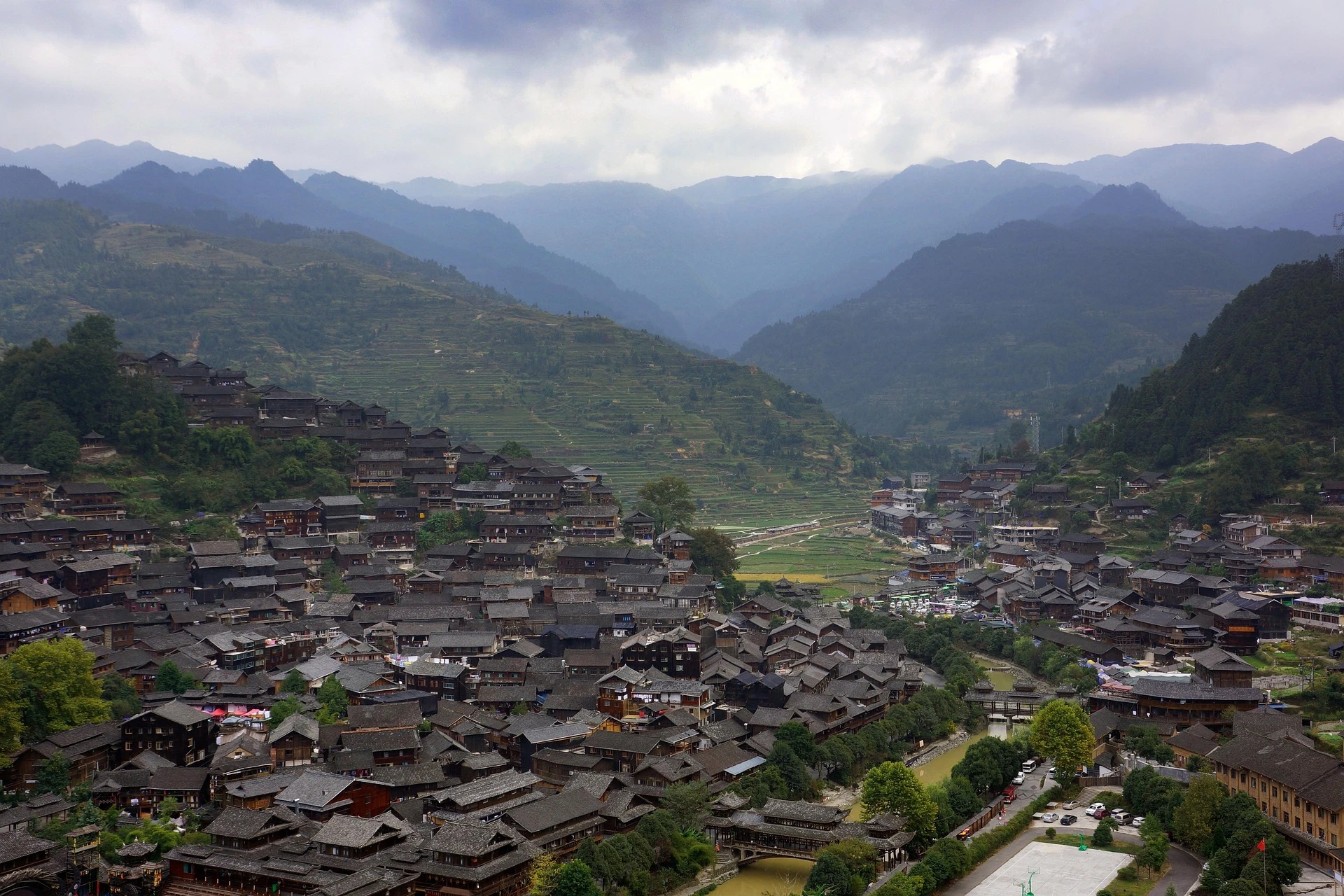
Longji Terraces cover 66 square kilometres (25 sq mi) of mountain slopes between 380–1,180m (1,247–3,871 ft) altitude, one hundred kilometres (62 mi) northwest of Guilin in Longsheng Ethnic Autonomous County. Zhuang and Yao communities began carving these layered fields starting in the Yuan Dynasty (1271 AD), seven hundred years of continuous farming history total.
Three distinct terrace zones cater to different traveller preferences:
Jinkeng (Dazhai) Thousand-Storey Windmill Terraces sit highest at 1,180m (3,871 ft), delivering the most dramatic wide-angle shots, run by Red Yao villagers and slightly harder to reach;
Ping'an Zhuang Village holds the classic Seven Stars Around Moon terrace layout printed on decades-old postcards at 1,000m (3,281 ft), ideal for quick day trips from Guilin, inhabited by Zhuang people;
Longji Ancient Zhuang Village preserves the original thousand-year-old terrace construction methods, with far fewer tourist crowds overall.
Red Yao women from Huangluo Long Hair Village hold a Guinness World Record—120 local ladies sport hair longer than 1.4m (4.6 ft), only cutting their locks once at age eighteen. Daily 10 AM and 3 PM river hair-washing ceremonies cost ¥50 (
$7) entry including photo opportunities.
Ping'an Zhuang stilt houses split three functional levels: ground floor shelters livestock, middle floors hold family living spaces, top attics store harvested grain. The carved welcome drum at the village entrance only gets struck by the village chief using a twelve-beat ritual rhythm—tourists cannot touch or hit the drum, locals believe it calls ancestral field spirits.
Two major annual cultural festivals draw crowds: the June second weekend Rice Transplanting Opening Festival, where five hundred Zhuang farmers plant the first rice seedlings in traditional costume alongside water buffalo, followed by a chaotic mud battle between young men and women—come prepared with full spare clothes and waterproof boots, mud splatters everyone without exception. The September Golden Sun-Drying Festival sees Red Yao ladies hang three-hundred-year-old hand-indigo wedding dresses and quilt covers across bamboo poles on every hillside balcony, turning the entire mountain deep blue, the single most photogenic day of the year.
Photography peak seasons: late May to early June flooded reflection season (seven days after seedling planting), October 1–15 golden mature rice harvest, plus rare frosty snow covering terraces January to February.
No paved roads lead up to the highest viewpoint lodges, so local Yao mountain porters carry tourist luggage up steep slopes. Official porter service charges ¥50 ($7) for twenty-kilogram bags over a one-hour climb, staffed by village women earning school fees for their children. Don't haggle prices below ¥30 (
$4)—porters carry
emergency first aid kits as part of their official work requirements, undercutting their wage hurts the whole village community.
Drone flights banned within a 2km (1.2 mi) radius of Ping'an and Jinkeng terraces; the layered geometric fields serve as military satellite remote sensing calibration sites. Violators face drone confiscation plus a ¥5,000 ($694) fine.